
The aim of the game
In the common 13-card Indian rummy format, you work towards a hand made entirely of valid sequences and sets. A valid declaration usually needs at least two sequences, including one pure sequence. The remaining cards must also belong to valid groups.
These are introductory rules. The number of players, decks, jokers, scoring and penalties can vary, so read the table rules before starting a game.
Start with a pure sequence
A pure sequence is three or more consecutive cards of the same suit, with no joker substituting for a missing card. For example, the five, six and seven of hearts belong together.
Valid pure sequence: consecutive ranks, one suit.
Understand sets and other sequences
A set is usually three or four cards with the same rank and different suits. Three eights of different suits form a set; two copies of the same eight do not create a valid set together.
Valid set: matching ranks, different suits.
An impure sequence uses a joker to stand in for a missing card. It can help complete a hand, but it does not replace the need for a pure sequence. Rules for printed jokers and the selected wild-card rank depend on the game.
Follow the turn
- Arrange your cards. Keep promising same-suit runs together and look for matching ranks.
- Draw one card. Choose from the available draw or discard pile according to the table rules.
- Reassess your groups. A new card may complete a sequence or change which cards you need.
- Discard one card. Finish your turn with the correct number of cards.
- Check a completed hand. Group all 13 cards correctly before declaring.
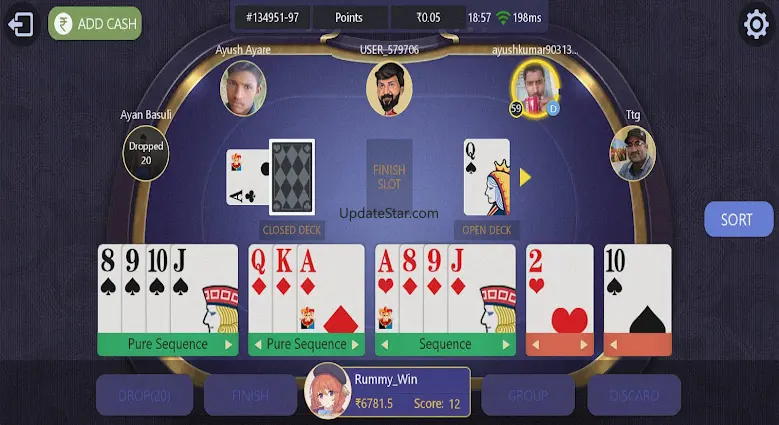
A complete 13-card example
The following example has two pure sequences and two sets. Every card is used once:
- 5♥ 6♥ 7♥ — pure sequence, three cards.
- 9♠ 10♠ J♠ Q♠ — pure sequence, four cards.
- 8♦ 8♣ 8♠ — set, three cards.
- 2♥ 2♦ 2♣ — set, three cards.
Check the rules that change
Aces may be used low in A–2–3 or high in Q–K–A where the rules permit, but K–A–2 is not a standard continuous sequence. Drop penalties, invalid-declaration penalties and maximum scores also differ between games.
Learn a format’s scoring before you begin. Do not assume that a tutorial example promises a particular result in a live game.
You can practise grouping cards with a physical deck. This website does not provide playable tables or require a payment to read the guide.